6 June 2026
AI Should Help You Write, Not Replace Your Voice
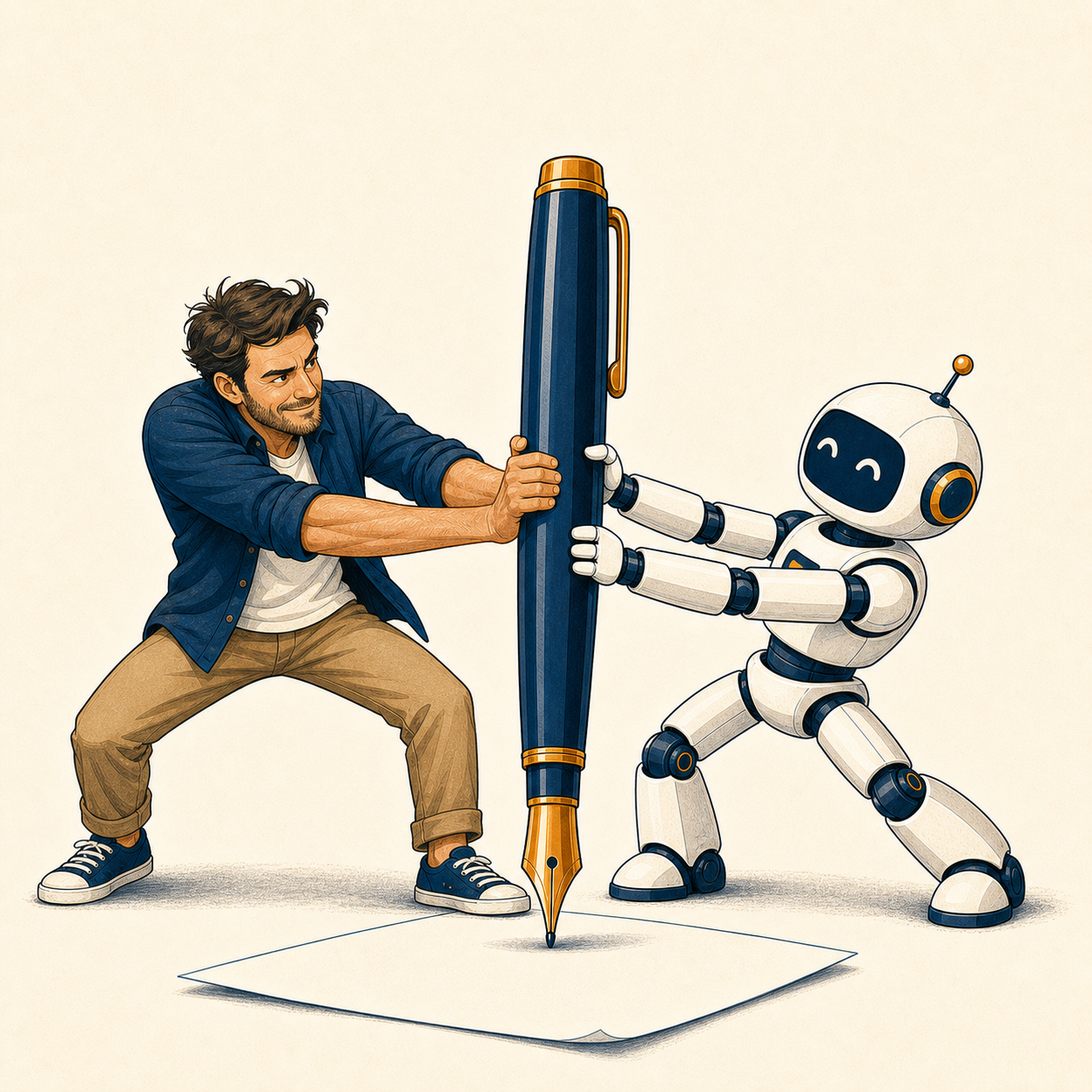
I work with AI every day.
So a lot of people assume there is no limit to where and how I use it.
Nothing could be further from the truth.
This was my first real post for Base38, so it felt right to talk about writing with AI and where I draw the line.
The downside of keeping up with everything AI
I want to stay on top of what is happening in AI, so I read a lot of articles and watch a lot of videos.
Some are from creators I already follow. Others are from new ones who offer a different perspective.
But more and more often, I can tell within seconds that a video was generated by AI, or that the text was written by it.
In some ways, that makes it less interesting.
My feed has turned almost entirely into AI-generated video at times, and it has made scrolling the algorithm a lot less fun.
Where I draw the line
When it comes to communication, I strongly believe a human should be the one actually communicating.
I am not interested in reading a post written entirely by AI, or watching a video that is supposed to inform me but was made entirely by a machine.
That does not mean AI has no place here.
I think it is a great tool for creating both of those things. There is just a different approach that works far better.
How I actually write this
For this post, and for most of what I write, I use an AI agent that takes a voice note I have recorded and turns it into something clear and readable.
Before that, the agent helps research the subject, so I am fully immersed and up to date. That saves me a lot of time.
But the agent has strict instructions.
It has to follow what I said. It is only allowed to trim or correct things that are clearly grammar, spelling, or natural English flow.
In other words, it is not there to replace the thought.
It is there to help the thought survive the trip from my head to the page.
The shortcut I do not want
There is a huge difference between:
- AI helping you express what you already think
- AI deciding what you think for you
The first one can be incredibly useful.
The second one is where content starts to feel empty.
I use AI to remove friction. I do not use it to remove myself from the work.
And it is not just me
LinkedIn has also warned about fully AI-written articles and low-quality AI content.
That is not surprising. People do not want to read a polished wall of generic words. They want a point of view, a lived example, and a person behind the message.
That is where I think AI works best for writing.
Not as the author.
As the tool that helps the author get the thought out more clearly.